Why Topological Manifolds.
Local coordinates, forms and paths to knowledge.
A topological manifold is a Hausdorff, second-countable space in which each point has a neighbourhood homeomorphic to an open subset of Euclidean space of a fixed dimension. The surfaces of a sphere and a torus are two-dimensional examples, although they are commonly represented in three-dimensional space.
These local descriptions are called charts; a collection of charts covering the manifold forms an atlas. The topological definition requires coordinate changes to be continuous with continuous inverses. Differentiability is an additional structure: smooth manifolds use compatible charts whose transition maps permit differential calculus.
The plural in the name points to the relationship between local descriptions and different global structures. Research, teaching, writing and personal journeys retain their individual character here. Geometry is a reference rooted in scientific study and rediscovered in the bodily exploration of form.
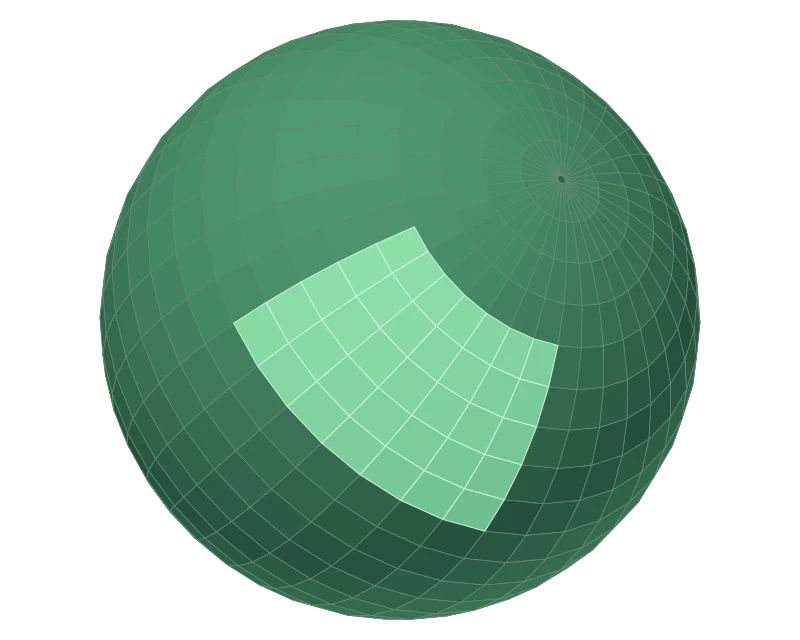
Sphere
The surface of a sphere has dimension two: two local coordinates suffice to identify a point. A single chart cannot cover the whole sphere; several descriptions are needed, as with maps of the Earth. A small coordinate region is highlighted in the illustration.
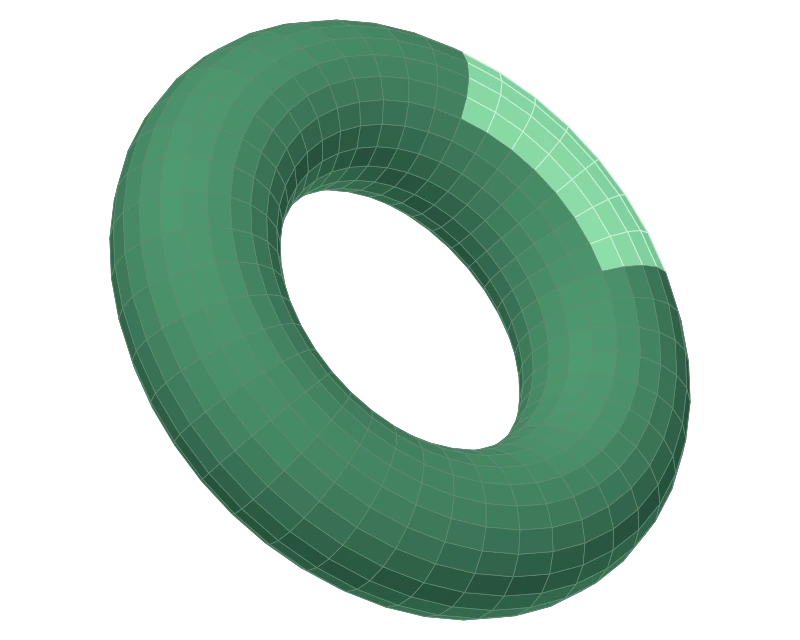
Torus
The surface of a torus also has dimension two. Locally it can be described like a region of a plane, while its global structure differs from that of a sphere. The curves follow the two directions of its parametrisation; the angular parameters are periodic and must be used locally as coordinates.
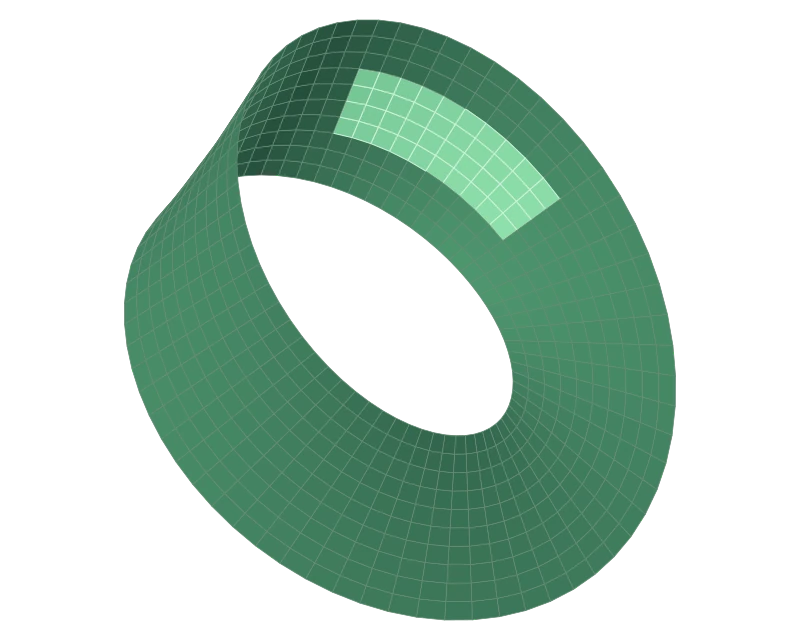
Möbius strip
The Möbius strip is a non-orientable surface with boundary. Interior points have neighbourhoods described by two coordinates; at the boundary the local model is a half-plane. It illustrates the distinction between local descriptions and global properties.
Colour highlights a local region of each surface. The figures describe mathematical properties and do not represent experimental measurements. The interactive atlas contains other objects, including fractals, graphs and illustrative models, not all of which are manifolds.
Knowledge, reality, experience
In this passage from the Timaeus, I find a question about the relationship between the order through which we seek to understand the world and the conditions in which it takes shape, a tension that continues to interest me in the study of models.
Read the passage
“Mind, the ruling power, persuaded necessity to bring the greater part of created things to perfection, and thus and after this manner in the beginning, through necessity made subject to reason, this universe was created.”
I read this passage as an invitation to examine the role of questions and measurements in describing physical reality, since a scientific representation requires clarity about the operations through which a phenomenon becomes knowable.
Read the passage
“It from bit. Otherwise put, every it—every particle, every field of force, even the space-time continuum itself—derives its function, its meaning, its very existence entirely—even if in some contexts indirectly—from the apparatus-elicited answers to yes-or-no questions, binary choices, bits. It from bit symbolizes the idea that every item of the physical world has at bottom—at a very deep bottom, in most instances—an immaterial source and explanation”
In the encounter with the mountains, I recognise a relationship between intention and concrete possibilities that, while exposing the limits of expectations, makes walking and climbing experiences through which one can also examine one’s own judgement.
Read the passage
“[Whymper] loved pitting his spirit against a formidable opponent - both physically and morally - to see who ended up winning. He then discovered that the mountains were harder than him, of a terrible hardness, and then he gave way. But, to arrive at this discovery, he had lived the most passionate years of his life”